









Buying supplements online in India can mean comparing bottles with different ingredients, capsule counts and serving sizes. The biggest number on the front of a pack does not always tell you what one serving contains or how long the bottle will last.
To read a supplement label, start with the serving size, check the amount of each listed ingredient, review the full ingredient list and compare the cost per serving in rupees. Then read the directions, storage instructions and expiry date.
This guide focuses on making clearer product comparisons. It does not recommend a supplement or dosage for your individual needs.
A quick supplement-label checklist
- What is the exact ingredient or formulation?
- How many capsules or tablets make up one serving?
- Are the listed quantities per capsule or per serving?
- What other ingredients and capsule-shell materials are listed?
- How many servings does the bottle contain?
- What is the cost per serving in rupees?
- Can you read the directions, storage instructions and expiry information?
1. Start with the serving size, not the capsule count
A bottle containing 60 capsules does not necessarily provide 60 servings. If the labelled serving is two capsules, it contains 30 servings.
Before comparing two products, write down both the number of capsules in a serving and the quantity declared for that serving. Otherwise, you might compare a single-capsule quantity on one bottle with a two-capsule quantity on another.
Use this calculation for comparison only. It is not a reason to change the directions on the label or advice from your healthcare professional.
2. Check what the ingredient number actually describes
Read the words beside a quantity, not just the number itself. Does it describe an entire blend, an oil, an extract or a separately listed component? If two products describe different things, matching their headline numbers will not give you a like-for-like comparison.
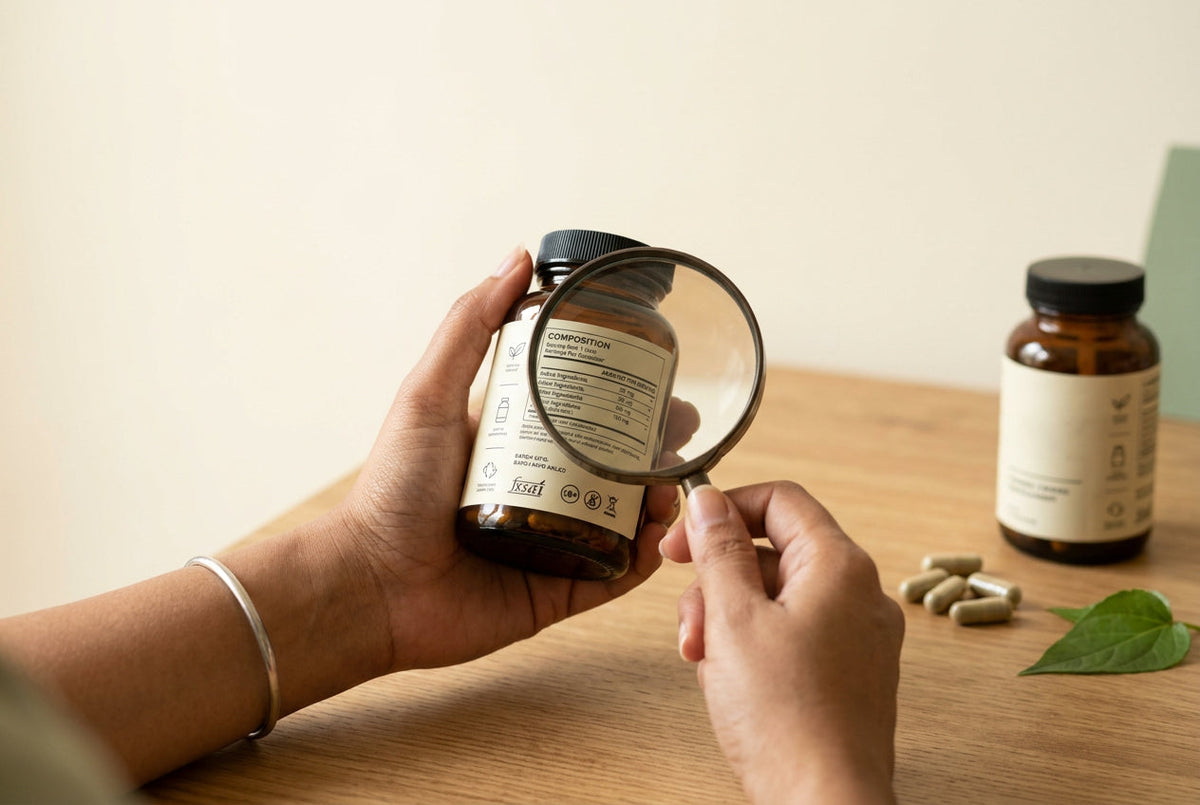
Look for a composition panel that clearly connects each listed quantity to an ingredient and a serving size. If that information is unclear in an online listing, ask for a readable label image before deciding.
3. Read the complete ingredient list
Do not stop at the ingredient highlighted on the front of the bottle. Review the other listed ingredients and the capsule shell, especially when shopping around dietary preferences or ingredients you avoid.
If vegetarian or vegan suitability matters to you, look for an explicit product statement and check the full formulation. Do not infer the suitability of a whole capsule from the source of its headline ingredient alone.
If you have an allergy or are unsure about an ingredient, ask a qualified healthcare professional and the manufacturer for clarification rather than relying on a product name.
4. Compare cost per serving in rupees
A lower bottle price does not automatically mean a lower cost per serving. Use the price you will actually pay and the labelled number of servings.
Cost per serving = bottle price ÷ number of servings.
Here is a hypothetical example, not GreenOpia product pricing:
- Bottle A costs ₹600 and contains 60 capsules. At two capsules per serving, it provides 30 servings and costs ₹20 per serving.
- Bottle B costs ₹450 and contains 30 capsules. At two capsules per serving, it provides 15 servings and costs ₹30 per serving.
Bottle A has a lower cost per serving in this example, but price alone does not establish which product is appropriate. Compare the ingredients and declared quantities too. A higher quantity is not automatically a better choice.
5. Check storage instructions before ordering
Think about where the bottle will sit in your home, particularly during hot weather in India. Read the product’s storage instructions rather than assuming a bathroom shelf, kitchen cupboard or refrigerator is suitable.
Check the expiry information on the pack you receive. If an online listing does not show enough information to make a confident purchase, request clarification from the seller.
6. Separate useful product information from advertising
Claims such as “ultimate wellness” do not help you calculate servings or understand a formulation. Give more attention to a readable label, specific composition information and clear directions.
Customer reviews can describe someone else’s experience, but they do not establish whether a supplement is suitable for you. Likewise, a long ingredient list or a large number on the pack is not a substitute for an individual assessment.
Questions to ask before buying a supplement online
If you cannot find the answer on the listing, ask the seller: Can I see the full label? Are these quantities per capsule or per serving? What is the capsule shell made from? Where can I find the storage directions?
A clear answer is more useful than guessing from a promotional image. Keep your comparison focused on the same measurements across products.
Frequently asked questions
Does a 60-capsule bottle last 60 days?
Not necessarily. At a labelled serving of two capsules, it contains 30 servings. How long it lasts depends on the directions applicable to that product and the advice you have been given.
Is the cheapest supplement bottle the best value?
Not necessarily. Compare cost per serving alongside the formulation and declared ingredient quantities. Different products may not be directly comparable.
Should I choose the supplement with the highest ingredient amount?
Do not choose by the largest number alone. This guide helps you compare labels; it does not determine what amount is appropriate for you.
What if I cannot read the label in an online listing?
Ask the seller for a clear image of the complete label and clarification of anything missing before purchasing.
The takeaway
When reading supplement labels in India, compare the serving size, ingredient quantities, full formulation and cost per serving. Check storage and expiry information, and ask questions when a listing is unclear.
For a product-specific example, review the composition and directions on GreenOpia’s Vegetarian DHA Omega-3 product page alongside the label on the pack you purchase.
If you are unsure whether you need a supplement, consult a qualified healthcare professional. Seek individual advice before starting if you take medicines, have a medical condition, are pregnant or breastfeeding, or are buying for a child. Do not replace prescribed treatment with a supplement.


