





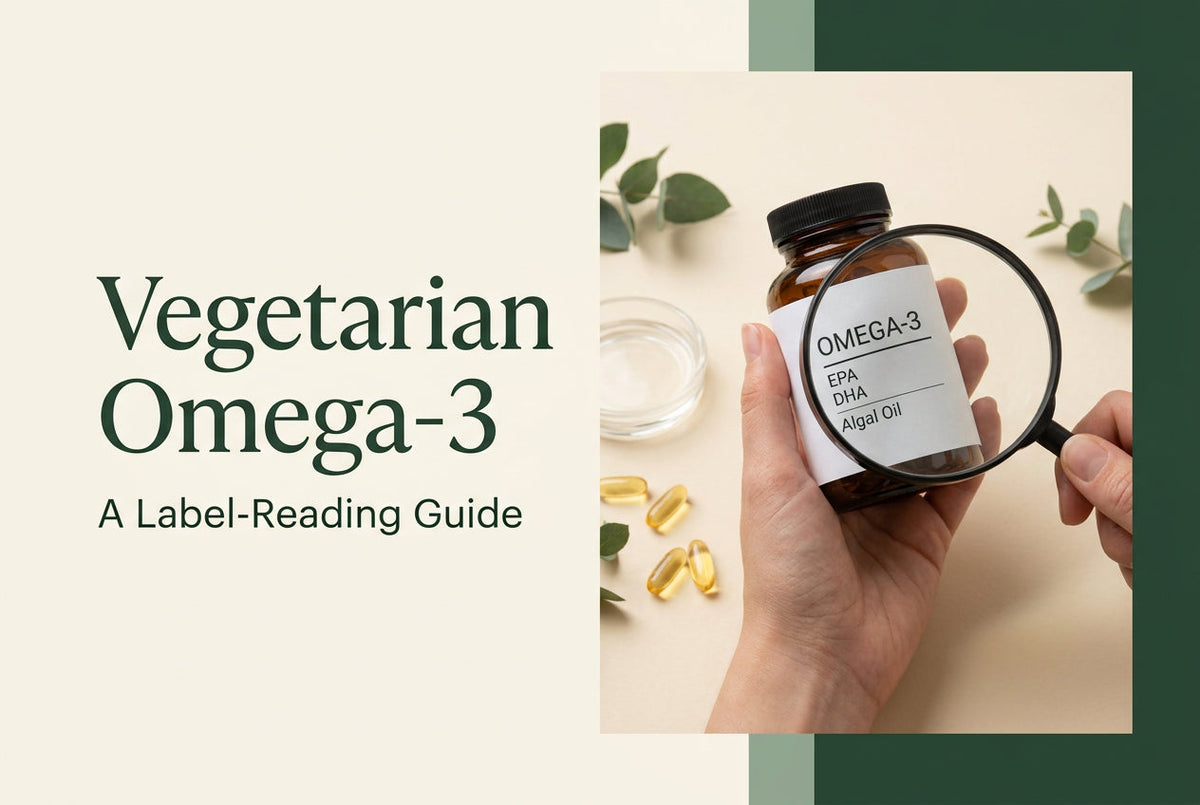
When choosing a vegetarian omega-3 supplement in India, check the oil source, the amount of DHA or EPA declared per serving, and the capsule-shell ingredients. Don’t compare products by the large “oil weight” number on the front of the bottle alone. The amount of oil and the amount of a particular omega-3 are not necessarily the same.
A useful label should make three things easy to understand: what the supplement contains, how much each serving provides, and how many capsules make up that serving.
What does “vegetarian omega-3” mean?
Vegetarian omega-3 products can contain different ingredients. Some use algal oil, while others use plant oils such as flaxseed oil. These should not automatically be treated as interchangeable.
Algal oil can provide DHA directly. Flaxseeds, chia seeds and walnuts primarily provide another form of omega-3 called ALA. When comparing supplements, identify the specific omega-3 declared on the label rather than assuming every product provides DHA or EPA.
The NIH Office of Dietary Supplements’ omega-3 fact sheet explains the differences between ALA, EPA and DHA and identifies algal oil as a vegetarian source of omega-3.
Also check the capsule shell. A plant-derived oil inside a gelatin capsule would not meet a vegetarian shopper’s requirements. Read both the oil source and the complete ingredient list.
Is algal oil the same as fish oil?
No. Algal oil comes from algae, while fish oil comes from fish. Their declared omega-3 composition can also differ.
For example, a product may declare DHA without listing EPA, while another may declare both EPA and DHA. Choose according to the information on that particular product, not a general assumption about the category. The NIH health professional fact sheet notes that some algal oil supplements contain EPA as well as DHA.
For shoppers avoiding fish-derived ingredients, algal oil is an option worth examining. A fish-free formulation should not, however, be assumed suitable for every allergy without checking the complete label and seeking appropriate advice.
Why oil weight and DHA content are different
A label stating “1,000 mg algal oil” does not necessarily mean it provides 1,000 mg DHA.
For example, GreenOpia’s current Vegetarian DHA Omega-3 product page declares 1,000 mg algal oil and 400 mg DHA per serving of two capsules. That equals 200 mg DHA per capsule.
This illustrates why serving size matters. Comparing one product’s two-capsule serving with another product’s single-capsule amount can give a misleading impression.
Before buying, compare the same information: capsules per serving, DHA per serving, EPA if declared, and servings per bottle.
How to compare value beyond the bottle price
Start with the number of servings, not just the number of capsules.
A bottle containing 60 capsules provides 30 servings when the labelled serving is two capsules. To calculate its cost per serving, divide the bottle price by 30.
Then compare products with similar declared compositions. A lower bottle price does not necessarily mean better value if the serving sizes or DHA amounts differ. Equally, a higher amount is not automatically the right choice for everyone.
What should Indian shoppers check before ordering?
Look for a readable ingredient list, clear vegetarian suitability, the declared DHA and EPA quantities, serving instructions, storage directions and an expiry date.
Pay attention to storage, especially if your home gets warm. Follow the temperature and storage instructions printed on the bottle rather than assuming any cupboard is suitable.
Avoid choosing a supplement solely because an advertisement promises dramatic results. Clear composition and realistic information are more useful than broad claims about “complete wellness.”
Do you need a vegetarian omega-3 supplement?
A supplement is not automatically necessary simply because you follow a vegetarian diet. The decision should take your usual food intake, individual needs and professional advice into account.
Speak with a qualified healthcare professional before starting if you are pregnant or breastfeeding, take medicines, have a medical condition, or are buying for a child. Do not use a supplement in place of prescribed treatment.
Frequently asked questions
Does vegetarian omega-3 always contain DHA?
No. Check the label. Vegetarian products may contain different oils and different forms of omega-3. Look specifically for a declared DHA amount if that is what you are comparing.
Does algal oil always contain EPA?
Do not assume it does. Check whether EPA is listed and how much the product declares.
Is 1,000 mg algal oil equal to 1,000 mg DHA?
No. Total algal oil weight and DHA content are different measurements. Read the composition panel for the actual DHA quantity.
Is a vegetarian capsule automatically vegan?
Do not assume so. Check the complete formulation and the manufacturer’s explicit dietary-suitability statement.
The takeaway
Choose a vegetarian omega-3 supplement by reading the full label, not just the front-of-pack number. Confirm the source, capsule ingredients, declared DHA or EPA, and serving size. Those details make comparisons clearer and help you ask better questions before buying.
For a product-specific example, view GreenOpia Vegetarian DHA Omega-3’s composition and directions.
References
- NIH Office of Dietary Supplements: Omega-3 Fatty Acids, Consumer Fact Sheet.
- NIH Office of Dietary Supplements: Omega-3 Fatty Acids, Health Professional Fact Sheet.
These references support the general nutrition information above. They do not constitute an endorsement of GreenOpia products or India-specific regulatory guidance.


