

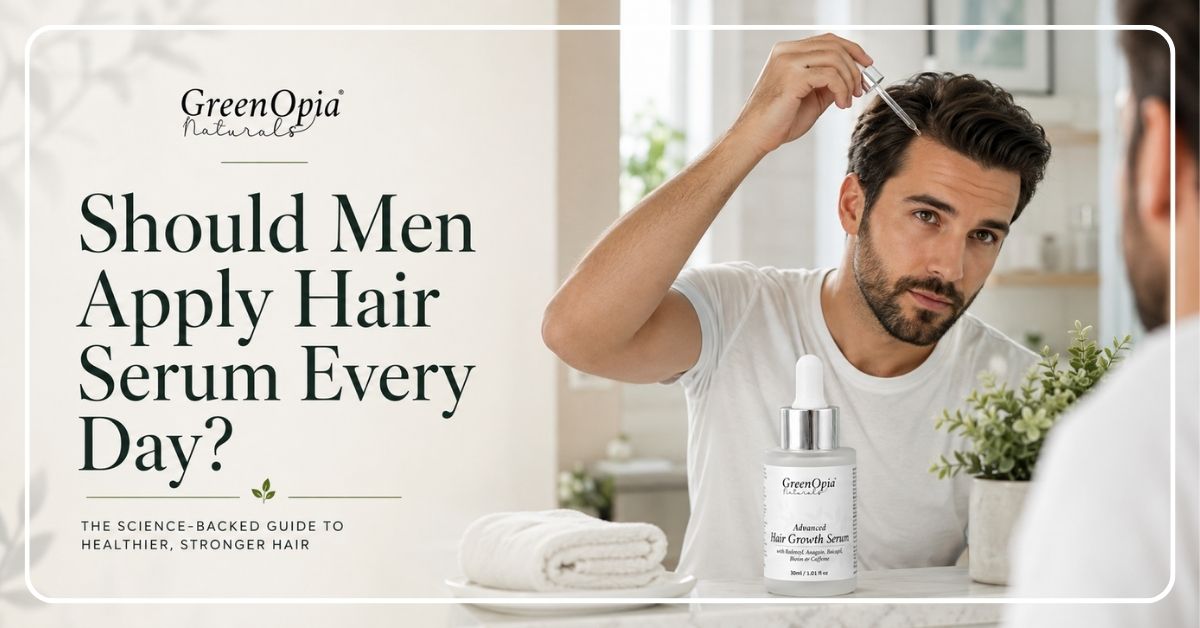
You notice more hair on your pillow. Your hairline seems slightly different in photographs. Or maybe your hair simply looks dry, flat and difficult to manage by the end of the day.
Naturally, you start looking for something you can add to your routine, and hair serum is usually one of the first products that appears.
So, is serum good for hair for men?
Yes, a well-chosen serum can be a useful part of a man's hair-care routine. But there is an important catch: not all hair serums do the same job.
Some serums are designed for the hair strands, helping with frizz, smoothness and manageability. Others are leave-in scalp serums formulated with cosmetic actives intended to support scalp care and the appearance of fuller, stronger-looking hair.
Understanding that difference can save you money, prevent unrealistic expectations and help you choose a product that actually suits your concern.
First, What Exactly Is a Hair Serum?
“Hair serum” has become a broad marketing term.
Two completely different products can both have the words hair serum written on the bottle.
1. Hair Styling Serum
This type is applied mainly to the mid-lengths and ends of the hair.
Its job may include:
- reducing frizz
- improving shine
- making hair easier to manage
- reducing friction between hair strands
- helping dry or rough hair feel smoother
- improving the appearance of damaged hair
It is primarily a cosmetic styling and conditioning product.
2. Scalp or Hair Density Serum
A scalp serum is different.
It is normally applied directly to the scalp rather than simply coating the hair lengths. Depending on its formulation, it may contain cosmetic ingredients such as peptides, caffeine, Redensyl™, AnaGain™, BAICAPIL™ or botanical extracts.
These products are usually positioned around scalp conditioning and supporting fuller, denser or stronger-looking hair.
And this distinction matters.
If your goal is controlling frizz before going to work, you probably need a styling serum.
If you are concerned about weak, thinning-looking hair, you are probably researching a scalp serum for men.
Is Hair Serum Actually Good for Men's Hair?
For many men, yes.
But the answer depends on your objective.
A serum may be useful if you want to:
- improve hair manageability
- reduce the appearance of frizz
- make dry hair feel smoother
- support hair exposed to styling damage
- reduce breakage caused by rough handling
- condition the scalp
- add a lightweight scalp-care step to your routine
- support the appearance of fuller, healthier-looking hair
What it cannot reasonably do is diagnose why your hair is falling or guarantee that lost hair will grow back.
That's a very different question.
Hair loss in men can have several causes, including hereditary male-pattern hair loss, medical conditions, medicines and repeated physical stress on the hair. The American Academy of Dermatology also distinguishes excessive hair shedding from actual hair loss because the underlying causes and management may differ.
So if you're losing considerable amounts of hair, don't make the serum bottle responsible for solving a problem that hasn't been diagnosed.
Benefits of Hair Serum for Men
Let's look at where a serum can genuinely fit into men's hair care.
1. It Can Help Hair Look Smoother and More Manageable
Men with medium-length, curly, dry, chemically treated or frequently styled hair may experience roughness and frizz.
A suitable hair-shaft serum can coat the hair surface and improve slip, which can make the hair easier to comb and style.
This matters more than it sounds.
Repeated friction, aggressive brushing and styling can contribute to hair breakage. Dermatologists recommend gentle handling because damaged hair becomes increasingly fragile.
2. A Leave-In Product Can Help Reduce Breakage
Hair that repeatedly undergoes blow-drying, straightening, colouring or rough towel drying can become vulnerable to damage.
The American Academy of Dermatology specifically recommends leave-in conditioners or detangling products as one way to help reduce breakage, split ends and frizz in fragile hair.
A serum is not identical to a conditioner, but a well-formulated conditioning serum can serve a similar cosmetic purpose depending on its ingredients.
Think of this as protecting the hair you already have, rather than making a hair-growth promise.
3. Scalp Serums Offer a Lightweight Alternative to Heavy Hair Oil
Not every man enjoys oiling his scalp.
If you work long hours, wear a helmet, exercise regularly or already have an oily scalp, applying a thick layer of oil may simply feel inconvenient.
This is one reason lightweight hair serum for men has become popular.
A leave-in scalp serum may provide a more practical format because it can often be applied in a small quantity directly to the scalp without coating the entire head of hair.
For example, GreenOpia Advanced Hair Growth & Scalp Serum is currently formulated as a lightweight, non-sticky leave-in serum containing 1% Redensyl™, 1% AnaGain™, 2% BAICAPIL™, 1% caffeine and Biotinoyl Tripeptide-1 complex. It is designed for regular scalp care and the appearance of fuller, stronger-looking hair rather than as a medicinal treatment for alopecia.
4. Some Scalp-Serum Ingredients Have Emerging Research Behind Them
You will often see names such as caffeine, Redensyl™, AnaGain™ and peptides on modern scalp serums.
There is growing research around some of these cosmetic actives, but consumers need to interpret that evidence properly.
Take caffeine.
A 2025 systematic review assessed nine clinical studies involving 684 participants using topical caffeine preparations. The findings generally favoured caffeine-containing products, but the researchers also reported important limitations. Evidence quality ranged from medium to very low across the studies, and the authors concluded that better-designed trials were needed before firm conclusions could be drawn.
A separate 2025 dermatology review examined popular topical ingredients including Redensyl, AnaGain and BAICAPIL. The authors found some promising research but also highlighted small sample sizes, inconsistent study designs, limited comparisons with established therapies and potential conflicts of interest.
That's the sensible way to read ingredient science.
Promising does not mean guaranteed.
5. It Can Encourage a More Consistent Hair-Care Routine
This benefit isn't glamorous, but it matters.
The best product sitting unopened in your bathroom isn't doing much for you.
A lightweight serum that takes 30 seconds to apply may be easier to use consistently than a complicated routine involving multiple oils, masks and treatments.
And hair care usually improves when you simplify it rather than constantly replacing products.
Can Hair Serum Stop Hair Loss in Men?
This is where we need a clear boundary.
A cosmetic serum should not be presented as a guaranteed treatment for male-pattern baldness, alopecia or another medical cause of hair loss.
Male-pattern hair loss, medically called androgenetic alopecia, is extremely common and tends to develop progressively. It may appear as a receding hairline, thinning crown or gradually enlarging bald area.
The American Academy of Dermatology lists established medical treatment options for male-pattern hair loss, including topical minoxidil and prescription finasteride. These are fundamentally different from cosmetic scalp serums.
So if you have a visibly receding hairline or progressive thinning, don't simply keep trying new cosmetic products for a year hoping the situation will correct itself.
A dermatologist can determine what type of hair loss you actually have.
Hair Growth Serum for Men vs Minoxidil: Are They the Same?
No.
This is one of the most important hair-care myths to clear up.
A cosmetic hair growth serum for men might contain cosmetic peptides, caffeine, botanical extracts and branded actives.
Minoxidil is a drug used for particular forms of hair loss.
They should not be placed in the same category simply because both are applied to the scalp.
If you already use minoxidil or another medicated scalp product, speak to your dermatologist before layering multiple leave-in products on the same areas.
You don't want a complicated cocktail on the scalp causing irritation or making it difficult to follow your prescribed treatment correctly.
How to Use Hair Serum for Men Properly
The correct technique depends on whether you're using a styling serum or a scalp serum.
For a Styling Serum
- Start with clean or slightly damp hair.
- Place a small amount in your palm.
- Rub it between your hands.
- Apply mainly through the mid-lengths and ends.
- Avoid overloading the roots, particularly if your scalp becomes oily easily.
- Add more only if required.
The biggest mistake is using too much.
More serum does not mean better-looking hair. It often means flatter-looking hair.
For a Scalp Serum
- Start with a clean, dry or slightly damp scalp unless the label states otherwise.
- Part your hair so you can reach the scalp.
- Apply a few drops to the intended areas.
- Gently spread it using clean fingertips.
- Do not scratch or aggressively massage the scalp.
- Leave it on according to the product directions.
- Use it consistently rather than applying a large quantity occasionally.
GreenOpia's current directions similarly recommend applying a few drops directly to a clean scalp, distributing gently and leaving the formulation on rather than immediately rinsing it away.
Should Men Apply Hair Serum Every Day?
Possibly, but read the individual product directions.
A styling serum may be used whenever required.
A leave-in scalp serum may be designed for regular or daily application, depending on the formulation.
The more important question is:
How does your scalp respond?
Stop or reduce use if you notice:
- redness
- persistent itching
- burning
- increased flaking
- bumps or irritation
Using five products every day isn't necessarily better than using two products consistently and correctly.
Men's Hair-Care Routine: What Matters More Than Serum
Hair serum can help, but your daily habits can easily undo its benefits.
Keep Your Scalp Clean
Choose a shampoo based on how oily your scalp gets, how much product you use and how frequently you exercise.
You don't need to scrub aggressively.
Massage the shampoo mainly through the scalp and let the lather rinse through the hair rather than repeatedly rubbing the hair lengths.
Use Conditioner
Men often skip this step, particularly with shorter hairstyles.
If your hair feels rough, dry or difficult to manage, conditioning may help reduce friction and improve manageability.
Be Careful With Wet Hair
Wet hair can be more vulnerable to mechanical stress.
Avoid aggressively rubbing your head with a towel.
Pat or wrap the hair gently and detangle without pulling.
Reduce Excessive Heat
If you're using a hair dryer every morning, avoid holding it centimetres from your scalp at maximum temperature.
Dermatologists recommend reducing blow-drying frequency and using lower heat because excessive heat can weaken and damage hair.
Don't Ignore Tight Hairstyles
Man buns, tightly tied ponytails, braids and other styles that repeatedly pull on the scalp aren't harmless simply because they look good.
Long-term tension can contribute to traction alopecia.
Keep hairstyles comfortable. Pain and constant pulling aren't signs of a hairstyle “holding well”.
Common Hair Serum Myths Men Should Stop Believing
Myth 1: Serum Makes Hair Grow Faster
Not necessarily.
A cosmetic serum may support scalp care or improve hair appearance, but it should not automatically be interpreted as a treatment that accelerates biological hair growth.
Myth 2: More Serum Means Better Results
No.
Using excessive amounts can lead to greasy hair, scalp build-up and wasted product.
Follow the recommended amount.
Myth 3: Hair Oil and Hair Serum Are the Same
They aren't.
Oils generally provide lubrication and conditioning. Styling serums mainly address hair appearance and manageability. Scalp serums are concentrated leave-in formulations designed around scalp care.
They may coexist in a routine, but they aren't interchangeable.
Myth 4: All Male Hair Fall Is Because of Stress
Stress can contribute to excessive shedding, but male hair loss has many possible causes.
Gradual temple recession or crown thinning, for example, may indicate male-pattern hair loss.
Self-diagnosing everything as “stress hair fall” can delay appropriate treatment.
When Should a Man See a Dermatologist About Hair Loss?
See a dermatologist rather than relying exclusively on serum if you notice:
- a progressively receding hairline
- noticeable crown thinning
- sudden heavy shedding
- clearly defined bald patches
- scalp pain
- severe itching
- scaling or persistent dandruff-like symptoms
- scalp redness or inflammation
- hair coming out in unusually large amounts
Hair loss can develop gradually or appear suddenly. Getting the correct diagnosis early can matter because some forms of hair loss become more difficult to manage as they progress.
So, Is Serum Good for Hair for Men?
Yes, hair serum can be good for men when the product matches the problem you're trying to solve.
If you have dry, rough or frizzy hair, a styling serum can improve smoothness and manageability.
If you're concerned about weak or thinning-looking hair, a lightweight scalp serum can be a convenient addition to your regular hair-care routine.
But keep your expectations realistic.
A cosmetic serum can support the appearance and condition of your hair and scalp. It cannot tell you why you're losing hair, nor should it replace appropriate medical care for diagnosed hair-loss conditions.
The practical formula is simple:
Clean scalp + gentle shampooing + conditioning + less unnecessary heat + sensible styling + appropriate scalp care.
That's far more useful than chasing a new miracle ingredient every month.
If you prefer a lightweight leave-in scalp serum, you can explore GreenOpia Advanced Hair Growth & Scalp Serum, formulated with 1% Redensyl™, 1% AnaGain™, 2% BAICAPIL™, 1% caffeine and Biotinoyl Tripeptide-1 complex for regular scalp care and fuller, stronger-looking hair.
Choose products based on your scalp, hair type and actual concern, then give your routine the consistency it deserves.
Frequently Asked Questions
1. Is hair serum good for men with thinning hair?
A scalp serum can be included in a routine for thinning-looking hair and may support scalp conditioning and the appearance of fuller hair. Progressive or significant thinning should be assessed by a dermatologist because a cosmetic serum does not treat every cause of hair loss.
2. Can men use hair serum every day?
Yes, some hair serums are designed for daily use, but follow the individual product directions. Use the recommended quantity and stop if persistent irritation develops.
3. Should men apply hair serum on wet or dry hair?
It depends on the type. Styling serums are often used on damp or dry hair lengths, while scalp serums may be applied to a clean, dry or slightly damp scalp. Always follow the instructions supplied with the product.
4. Does hair serum cause hair fall in men?
A properly selected serum should not normally cause hair fall. However, irritation, excessive build-up or rough application may create problems. Stop using the product and seek professional advice if you notice unusual shedding, redness, itching or scalp discomfort.
Sources & Expert References
- American Academy of Dermatology: Male-pattern hair loss, signs and established treatment considerations.
- American Academy of Dermatology: Dermatologist recommendations for reducing breakage, heat damage and styling-related hair damage.
- American Academy of Dermatology: Hair shedding versus hair loss and the importance of identifying the cause.
- Szendzielorz & Spiewak, Healthcare, 2025: Systematic review of clinical evidence concerning topical caffeine preparations.
- International Journal of Trichology, 2025: Review of topical cosmetic actives including Redensyl, AnaGain and BAICAPIL, including limitations of available evidence.
- GreenOpia Advanced Hair Growth & Scalp Serum: Current formulation, positioning and usage instructions.
Medical-information disclaimer: This article provides general hair-care information and is not a diagnosis or substitute for professional medical advice. Sudden, severe, patchy or persistent hair loss should be assessed by a qualified dermatologist.


