

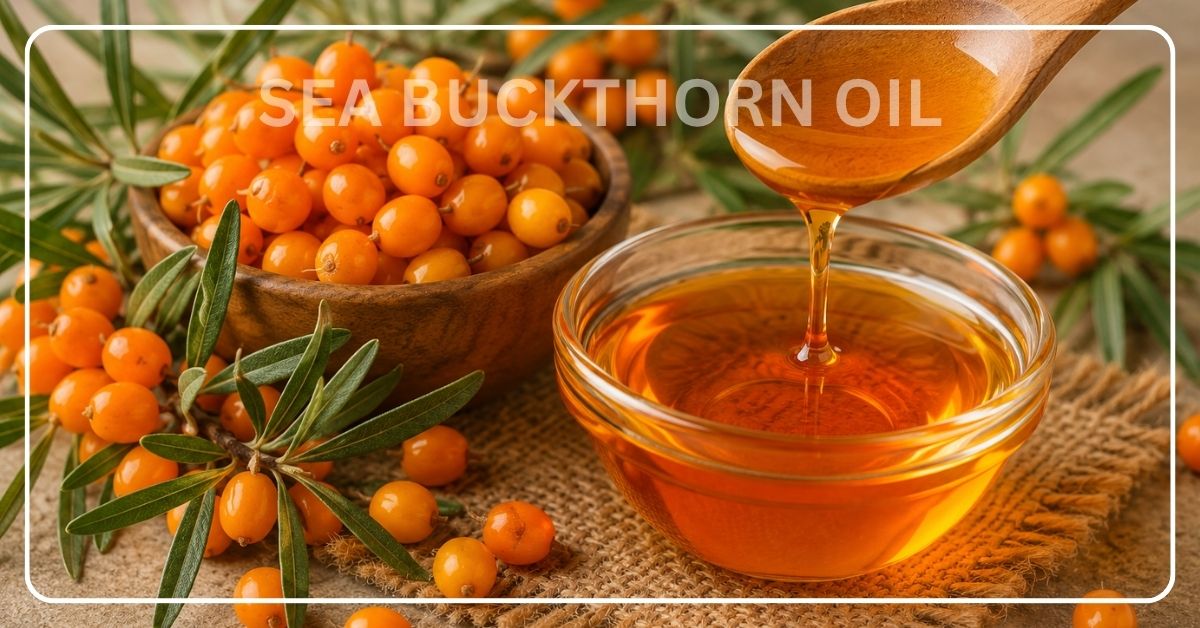
Sea buckthorn berries pack an unusually dense mix of vitamins, carotenoids, and fatty acids into a very small fruit — but how that oil is pulled from the berry matters almost as much as what's inside it. CO₂ extracted sea buckthorn oil has become the benchmark for quality, and for good reason: supercritical CO₂ extraction keeps delicate nutrients intact in a way that heat- and solvent-based methods often can't.
What Makes Sea Buckthorn So Nutrient-Dense
Hippophae rhamnoides, the shrub behind sea buckthorn oil, produces small orange berries loaded with vitamin C, vitamin E (as tocopherols), carotenoids like beta-carotene and zeaxanthin, flavonoids, phytosterols, and a fatty acid profile spanning omega-3, 6, 7, and 9. The omega-7 fraction — palmitoleic acid — is what sets sea buckthorn apart, since very few plant sources carry meaningful amounts of it. Oil can be pressed from the pulp, the seeds, or both, and the two sources don't share an identical fatty acid profile — seed oil tends to carry a larger share of polyunsaturated fats, while the pulp is where much of the omega-7 and carotenoid content concentrates. The catch is that most of these compounds are fragile. Heat, oxygen, and harsh solvents can degrade them before the oil ever reaches a capsule.
Inside Supercritical CO₂ Extraction
Supercritical CO₂ extraction works by pressurizing carbon dioxide past its critical point, where it behaves as both a gas and a liquid at once. In this state, it moves through plant material the way a gas would, while dissolving oils and bioactive compounds the way a liquid solvent would. The CO₂ carries these dissolved compounds into a separator, where a controlled drop in pressure turns the CO₂ back into gas, leaving behind a concentrated, solvent-free oil. Because the entire process runs at comparatively low temperatures, it avoids the prolonged heat exposure that conventional extraction methods rely on. Carbon dioxide is a practical choice of solvent here precisely because it's non-toxic, non-flammable, and naturally abundant — once the run is finished, it can be recovered and reused in a closed loop rather than discarded.
Why This Method Protects More Nutrients
The practical effect shows up under lab analysis. One peer-reviewed study of CO₂-extracted sea buckthorn byproducts found the resulting extracts were rich in carotenoids — including zeaxanthin, beta-carotene, and lycopene — alongside meaningful tocopherol and palmitoleic acid content, with alpha-tocopherol as the dominant form. Separate research comparing extraction methods found that supercritical CO₂ pulled higher phytosterol levels from sea buckthorn seeds than cold pressing or hexane extraction did. Two properties explain the gap: CO₂ is chemically inert, so it doesn't oxidize fatty acids the way air exposure can, and it leaves no solvent residue behind, since it simply evaporates once pressure is released. Most sea buckthorn extractions also run well under 60°C — far cooler than the temperatures reached during prolonged heat-pressing or steam distillation. Heat-sensitive compounds like tocopherols and carotenoids, which normally break down under prolonged high temperatures, largely come through intact.
Choosing CO₂-Extracted Sea Buckthorn Oil
When comparing sea buckthorn supplements, the extraction method listed on the label is a genuine quality signal, not just marketing language. Oil obtained through supercritical CO₂ extraction is more likely to retain its natural omega-7 content, antioxidant carotenoids, and vitamin E, without the chemical residues associated with solvent-based processing. GreenOpia's premium sea buckthorn oil is sourced from high-altitude Ladakh berries, processed using supercritical CO₂ extraction, and lab-tested for purity before being filled into vegetarian capsules.
Extraction method rarely gets the spotlight in supplement marketing, but for a berry as nutritionally complex as sea buckthorn, it's often the difference between an oil that's genuinely potent and one that's already lost much of its value before it reaches the bottle.


